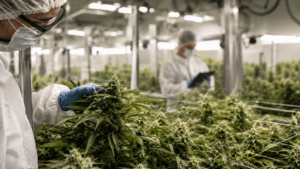

On 4 October 2024 the CJEU delivered its long-awaited judgment in Case C-793/22, Biohemp Concept SRL, concerning the refusal of authorisation to grow hemp in hydroponic systems inside enclosed spaces.
Facts of the case
- Biohemp Concept applied for authorisation to grow hemp on a total area of 0.54 hectares, including a building used as a protected growing space.
- The agricultural authority granted authorisation for 0.50 hectares but refused the remaining 0.04 hectares, arguing that this area was not agricultural land but a building that did not meet national legal requirements.
- Biohemp Concept challenged the decision, arguing that the building was actually used for cultivation and that the interpretation of “agricultural area” was too restrictive.
Question referred for a preliminary ruling
The national court asked the CJEU whether Regulations (EU) No 1307/2013 and No 1308/2013, and Article 38 TFEU, must be interpreted as precluding national rules that prohibit growing hemp (Cannabis sativa) in hydroponic systems in enclosed spaces.
The CJEU’s decision
- The CJEU recognised that hemp is covered by the Common Market Organisation (CMO) established by Regulation No 1308/2013 and that there is no explicit exclusion of hydroponic systems in enclosed spaces.
- A national ban could affect farmers’ access to the market and the proper functioning of the CMO, unless it is justified by a legitimate objective such as the protection of public health.
Protection of public health
- The CJEU accepted that protecting public health is a legitimate objective that can justify restrictions.
- The ban must be appropriate and proportionate to achieve this objective and must not go beyond what is necessary, taking into account the objectives of the Common Agricultural Policy (CAP) and the functioning of the CMO.
Role of the national court
- It is for the national court to assess whether the ban is applied consistently and systematically and whether less restrictive measures could achieve the same public health objective.
- It must also consider whether monitoring the THC content of the plants could be an effective alternative to an outright ban.
Conclusion
The CJEU concluded that EU law does not preclude a national ban on growing hemp in hydroponic systems in enclosed spaces, provided that:
- The ban is appropriate for ensuring the objective of protecting public health.
- It does not go beyond what is necessary to achieve that objective, taking into account the objectives of the CAP and the proper functioning of the CMO.
Implications
- Member States may restrict hemp cultivation in hydroponic systems if the restrictions are justified and proportionate in relation to the protection of public health.
- Farmers and companies wishing to grow hemp in these conditions should keep a close eye on national rules and on possible public health justifications.
The distinction between producing and marketing hemp and CBD in the European Union
Comparative analysis of the Court of Justice of the European Union (CJEU) rulings on high-CBD hemp
Following this new CJEU judgment in Biohemp Concept SRL, which focuses on hemp production, we compare it with the landmark Kanavape ruling, which focuses on marketing.
Legal background and case law
Hemp (Cannabis sativa L.) and its derivatives, especially cannabidiol (CBD), have sparked intense legal debate in the European Union (EU). Through two judgments, the Court of Justice of the EU (CJEU) has clarified key aspects of what Member States can and cannot do regarding the production and marketing of these products.
Case C-793/22: Biohemp Concept SRL
Case: Biohemp Concept SRL applied in Romania for authorisation to grow hemp in an enclosed space with a hydroponic system.
Decision: The Romanian authorities refused authorisation for cultivation in enclosed spaces, arguing that it was not “agricultural land” and raising concerns about a potential increase in THC.
CJEU analysis: The Court held that cultivation in enclosed spaces with hydroponic systems can be classified as an “agricultural area” under Regulation No 1307/2013. However, it recognised that Member States may impose restrictions on production for public health reasons, provided they are proportionate and necessary.
Case C-663/18: B S and C A (Kanavape)
Case: B S and C A were prosecuted in France for marketing an e-cigarette (Kanavape) containing CBD extracted from the whole hemp plant.
Decision: French rules prohibited the marketing of products derived from parts of the hemp plant other than the fibre and seeds.
CJEU analysis: The Court ruled that CBD extracted from the whole hemp plant cannot be considered a narcotic drug and that the French ban was an unjustified restriction on the free movement of goods under Articles 34 and 36 TFEU.
Key distinction: production vs marketing
Limits on production
Member States may restrict the production of hemp and its derivatives under certain conditions:
- Protection of public health: States may restrict production where there are legitimate public health concerns, such as the risk that growing techniques could raise THC content above legal limits.
- Proportionality and necessity: Any restriction must be proportionate and necessary. It must be based on scientific data showing a real risk, not on mere assumptions or hypotheses.
- Example in C-793/22: Romania banned cultivation in enclosed spaces with hydroponic systems over fears of increased THC. The CJEU recognised that, while States may impose such restrictions, they must show that they are necessary and proportionate.
Marketing cannot be restricted
Member States cannot restrict the marketing of CBD and CBD flowering tops without THC when:
- They are not narcotic drugs: The CJEU established that CBD is not a narcotic drug, as on the basis of current scientific knowledge it has no psychotropic or harmful effects on human health.
- Free movement of goods: Banning the marketing of CBD lawfully produced in another Member State is a restriction on the free movement of goods, in breach of Articles 34 and 36 TFEU.
- No valid justification: States cannot justify such a ban on public health grounds unless they can show a real and specific risk associated with CBD.
- Example in C-663/18: France’s ban on marketing CBD extracted from the whole plant was found to be unjustified. The Court stressed that, since CBD is not a narcotic drug, banning it could not be based on public health protection without concrete evidence.
Implications for Member States
What EU Member States can do with CBD hemp
- Regulate production methods: impose requirements and controls on growing methods, especially where there are potential risks linked to THC content.
- Adopt proportionate measures: implement measures that are necessary and proportionate to protect public health, based on solid scientific data.
What EU Member States cannot do with CBD hemp
- Ban the marketing of legal CBD: they cannot ban the marketing of CBD and CBD flowering tops without THC that have been lawfully produced in another Member State.
- Treat CBD as a narcotic without scientific basis: they cannot classify CBD as a narcotic drug without scientific evidence to support that classification.
- Impose unjustified restrictions: they cannot adopt measures restricting the free movement of goods without valid justification and without respecting the principle of proportionality.
Analysis of CBD flowering tops without THC
According to the CJEU’s reasoning, hemp flowering tops that do not contain THC (or contain only low levels that have no narcotic effect) but do contain CBD:
- Cannot be considered narcotic drugs: according to the CJEU, these flowering tops cannot be classified as narcotic drugs, as they have no psychotropic effects.
- Free movement guaranteed: their marketing must be allowed within the EU internal market, provided they comply with EU rules.
- Unjustified national restrictions: any attempt by a Member State to ban their marketing without a solid scientific basis and without showing a real risk to public health would be contrary to EU law.
Conclusions
The CJEU judgments in Cases C-793/22 and C-663/18 set important precedents:
- Essential distinction: There is a clear distinction between producing and marketing hemp and its derivatives. States may restrict production under certain conditions, but they cannot ban the marketing of legal products such as CBD and flowering tops without THC.
- Compliance with EU law: Member States must ensure that their national rules are in line with EU law, especially as regards the free movement of goods.
- Protection of public health: Although public health is a priority, the measures adopted must be proportionate, necessary and based on concrete scientific evidence.
Recommendations for operators in the sector
It is essential for producers and traders to keep up to date with EU rules, the approach of national authorities in the different Member States and the CJEU’s interpretations.
In the event of unjustified restrictions, it is possible to go to the national courts and, ultimately, the CJEU to enforce the rights conferred by EU law.
In short, CJEU case law holds that CBD and CBD flowering tops without THC (or with only residual THC) cannot be considered narcotic drugs.
While Member States have some discretion to regulate production on public health grounds, they cannot ban the marketing of these products without a valid and proportionate justification. The free movement of goods is a fundamental principle that must be respected, ensuring a coherent and harmonised internal market.
Author: Bernardo Soriano – S&F Abogados
Need legal advice?
At S&F Abogados we specialise in cannabis law. Discover our service for CBD and hemp businesses, book an online consultation or call us on +34 919 532 802.