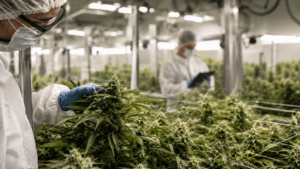

Medical cannabis regulation in Spain has taken an unexpected turn and, for the cannabidiol (CBD) sector, it represents a crucial victory. After intense pressure from associations, companies and legal experts, the Ministry of Health has removed from the draft Royal Decree the controversial article 3.1, which sought to classify cannabis flowering tops as narcotics regardless of their tetrahydrocannabinol (THC) content. This decision marks a milestone for the CBD industry in Spain, which was on the verge of an unprecedented regulatory blow.
A regulatory attempt with devastating consequences
The first version of the draft Royal Decree, presented by the Spanish Agency of Medicines and Medical Devices (AEMPS), caused great concern in the CBD sector. In its initial wording, the text introduced a provision implying that any cannabis flowering top, regardless of its THC content, should be considered a narcotic. Had it been approved, this measure would have meant the end of the CBD flower market in Spain, as it equated these products with controlled substances, hindering their sale and creating an unsustainable legal framework for producers and distributors.
The impact would have been devastating. Companies producing and selling CBD flowers would have seen their survival threatened, forced to stop trading or move to countries with more favourable rules. Consumers who use CBD flower for conditions such as anxiety, insomnia or chronic pain would suddenly have found themselves without legal access to these products. Moreover, the measure contradicted the position of the Court of Justice of the European Union (CJEU), which has ruled that CBD cannot be considered a narcotic if it has no psychoactive effects.
The sector’s response: mobilisation and effective pressure
Faced with this threat, the CBD sector reacted quickly and forcefully. Business associations, legal experts and medical cannabis advocates launched a pressure campaign on several fronts:
- Media mobilisation: Several media outlets covered the issue, giving a voice to producers, distributors and consumers who warned of the negative impact the rules would have in their original form.
- Legal and political action: Legal reports were prepared detailing the unlawfulness and disproportionality of the measure and submitted to national and European bodies.
- Participation in the public consultation: During the information and objections period, many players in the sector submitted formal objections highlighting the economic and social impact of the measure.
- Pressure in forums and public spaces: The sector’s position was defended at various events, conferences and meetings with key regulatory players.
- Coordination with international players: European organisations specialising in cannabis regulation were alerted to the restrictive direction Spain was taking.
This coordinated response achieved its goal: the final version of the Royal Decree sent to the European Commission no longer contains the provision that sought to control cannabis flowering tops regardless of their THC content.
A key victory, but insufficient regulation
Although the removal of article 3.1 is a great triumph for the CBD sector, the regulation approved remains deeply limited. The rules the Ministry of Health has sent to Brussels focus exclusively on dispensing magistral formulas from standardised cannabis extracts, leaving out the sale of plant-derived products in community pharmacies and completely excluding CBD flowers as a therapeutic option.
In practice, this means that the regulation does not address the reality of the current market or offer viable solutions for the companies operating in it. It is a regulation that is dead on arrival, as it does not meet existing demand or solve the legal problems faced by operators in the sector.
The impact on the CBD sector in Spain
In the short term, removing the control of cannabis flowering tops avoids a total crisis in the sector. However, companies continue to operate in an uncertain regulatory framework, with ambiguous rules and no official recognition of CBD products on the Spanish market.
In the long term, the lack of clear and favourable CBD regulation may lead companies to leave for more open European markets. This would mean a loss of competitiveness and economic opportunities for Spain, which is still failing to take advantage of the potential of a sector that is booming globally.
Next challenges and the way forward
Despite the victory achieved with the removal of article 3.1, the CBD sector still faces many challenges:
- Regulatory recognition: It is essential for CBD to have its own regulatory framework that allows it to be sold with guarantees and legal certainty.
- Access to pharmaceutical and retail markets: The rules should allow CBD products to be sold in pharmacies and specialist shops.
- Clarity on control: The current ambiguity around the control of CBD products creates uncertainty for companies and consumers.
- Support from the scientific community: More research and academic backing are needed to establish CBD as a product with officially recognised therapeutic uses.
Conclusion: a step forward, but not the end of the road
The removal of article 3.1 of the Royal Decree is an unquestionable victory for the CBD sector in Spain, achieved thanks to pressure and mobilisation by companies, associations and legal experts. However, the rules remain insufficient and leave many questions unresolved. Spain now has the opportunity to correct its approach and develop regulation that not only protects public health but also drives an industry with enormous economic and therapeutic potential.
The road to comprehensive CBD regulation is far from over, but this victory shows that resistance and coordinated action can make a difference. The challenge now is to keep moving forward and prevent Spain from falling behind in a market that, in the rest of Europe, continues to grow without unnecessary restrictions.
Do you need legal advice?
At S&F Abogados we specialise in cannabis law. Find out about our service for CBD and hemp businesses, send us an online enquiry or call us on +34 919 532 802.