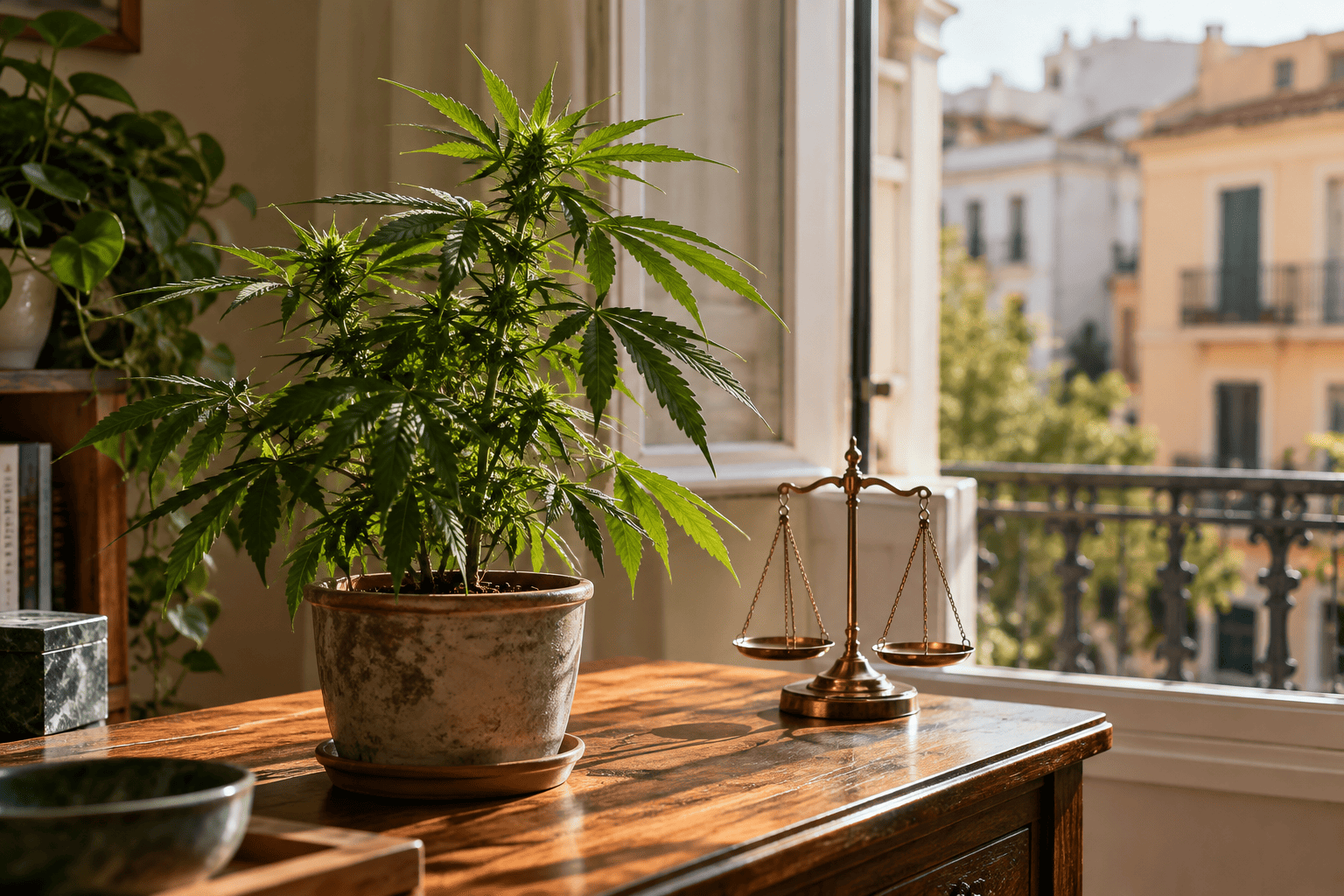
Growing cannabis in Spain raises a lot of questions because there is no rule that simply states that growing cannabis at home is, as a general matter, “legal” or “illegal”. The answer depends on circumstances such as what the cannabis is intended for, where the plants are located, whether they can be seen from public spaces and whether there is any evidence of supply to third parties.
One of the most common misconceptions is that the law allows a certain number of plants to be grown at home. However, Spanish law does not set a specific number of cannabis plants that a person may legally grow for personal use.
Whether a grow may have criminal or administrative consequences can only be determined by analysing each case individually. In this article we explain the main points you need to know about growing cannabis at home in Spain.
What does Spanish law currently say about home cultivation of cannabis?
In Spain, the legal treatment of cannabis cultivation has to be analysed mainly from two different angles: criminal law and administrative sanctions law.
On the one hand, Article 368 of the Criminal Code punishes, among other conduct, the cultivation, production or trafficking of toxic drugs, narcotics or psychotropic substances when aimed at promoting, encouraging or facilitating their illegal consumption.
This means that not every cannabis grow automatically amounts to an offence against public health. One of the key elements is establishing the purpose of the cultivation.
When there is sufficient evidence that the cannabis is intended to be distributed or supplied to other people, the risk of the conduct being considered a criminal matter increases considerably.
By contrast, when the grow is intended exclusively for the grower’s own consumption, the situation may be different. Personal consumption in itself is not classified in Spain as an offence against public health.
That said, this does not mean that growing cannabis for your own use is covered by any general authorisation.
In addition to the Criminal Code, you need to take into account Organic Law 4/2015 on the protection of public safety, which provides that certain drug-related conduct may constitute administrative offences even when it is not serious enough to be considered a crime.
For this reason, to properly assess a case of growing cannabis in Spain, you always have to distinguish between three concepts:
- Personal consumption in a strictly private setting.
- Administrative offences related to cultivation or possession.
- Grows that, because of their circumstances, may constitute an offence against public health.
The line between these situations does not depend solely on whether there are plants.
How many cannabis plants can you have at home?
This is probably one of the most frequently asked questions about home growing.
The answer is clear: in Spain there is no rule that expressly authorises growing one, two, three or any other specific number of cannabis plants for personal consumption.
Statements such as “you can legally have three plants per person” or “up to five plants counts as personal use” therefore do not accurately reflect how Spanish law works.
The number of plants may be one of the factors taken into account, but it is not the decisive criterion on its own.
When determining whether a grow was intended for personal consumption or whether there may have been an intention to distribute, many circumstances can be examined, including:
- The number and size of the plants.
- The total amount of cannabis the grow could produce.
- How far the plants have developed.
- The amount of substance actually seized.
- The personal circumstances and consumption habits of the person under investigation.
- Whether there are instruments for weighing or preparing doses.
- The presence of cash or other items related to possible sales.
- Communications or actions that may indicate distribution to third parties.
- The location and features of the growing set-up.
Consequently, there is no figure that guarantees that a grow automatically falls outside the scope of criminal law.
A distinction must also be drawn between the number of plants and the amount of usable substance they could yield. Two grows with exactly the same number of plants may have completely different characteristics depending on their size, estimated yield and other circumstances.
That is why, in proceedings involving cannabis plantations, it is particularly important to carry out an overall analysis of the evidence rather than simply counting the plants seized.
What happens if the plants can be seen from the street?
Where the plants are located is another key issue.
Organic Law 4/2015 on the protection of public safety classifies as an administrative offence certain acts of illicit planting and cultivation of drugs in places visible to the public, when the conduct does not constitute a criminal offence.
This provision has important practical consequences.
A grow on a balcony, terrace, garden, patio or any other part of the home may raise administrative problems if the plants are clearly visible from a street, square, path or any other place accessible to the public.
Therefore, the fact that the plants are on private property does not necessarily mean that any risk of a penalty disappears.
In these cases, the key factor is precisely visibility from a public space.
This administrative offence must also be distinguished from a possible offence against public health. If the circumstances of the grow suggest an intention to traffic or distribute, the issue would no longer be limited to the possible application of the Public Safety Act, and the Criminal Code could come into play.
In other words, there are two different levels:
A grow visible to the public may lead to administrative consequences even when there is not enough evidence to consider that a crime has been committed.
On the other hand, a grow that cannot be seen from the street is not automatically excluded from the scope of criminal law if there is evidence that it was intended to supply cannabis to third parties.
The lack of visibility, therefore, does not in itself make the grow legal.
When can growing cannabis in Spain become a criminal or administrative problem?
To understand the risks involved in growing cannabis in Spain, it is essential to distinguish between situations where there may be an administrative offence and situations where the facts may become a criminal matter.
Possible administrative consequences
Administrative liability may arise, among other cases provided for in public safety legislation, when acts of illicit planting or cultivation take place in places visible to the public and the facts do not constitute a crime.
There are also administrative restrictions on the illicit consumption or possession of drugs in certain public spaces.
So the fact that a given conduct is not a crime does not necessarily mean that it has no legal consequences.
Possible criminal consequences
The situation can be much more serious when there are signs that the cannabis produced was not intended solely for the grower.
Article 368 of the Criminal Code is aimed in particular at conduct that promotes, encourages or facilitates the illegal consumption of drugs by other people.
In a criminal investigation, different elements may be assessed together.
A high cannabis yield may be relevant, but it will normally have to be analysed together with the other circumstances. The division of the substance into different bags or containers, precision scales, sales records, conversations with buyers, large amounts of cash or any other evidence suggesting possible distribution may also be significant.
Context is therefore crucial.
Having several plants does not automatically mean that there is drug trafficking. Likewise, claiming that the cannabis was for personal use does not prevent an investigation when there is objective evidence pointing the other way.
Each case must be analysed individually
When it comes to cannabis, many doubts arise precisely because people try to apply general rules to situations that, legally, depend on numerous factors.
There is no rule under which a certain number of plants always means personal use, nor any rule under which exceeding a specific figure automatically turns the grow into a crime.
In criminal proceedings, issues such as the actual amount of cannabis seized, its potency, the production potential of the plants, the growing conditions, the consumption habits claimed and the other evidence gathered during the investigation can be particularly important.
The legal defence must also examine how the police intervention took place, the evidence added to the case file and how the prosecution intends to prove an alleged intention to distribute.
So, is it legal to grow cannabis for personal use in Spain?
Simply talking about “legal home growing” can be misleading.
Private consumption and growing exclusively for your own use are treated very differently in law from cannabis trafficking, but that does not mean that Spain has a general authorisation to grow cannabis freely at home.
In practical terms, there are several essential points to bear in mind:
There is no legal number of plants. Spanish law does not set a number of plants that can automatically be grown without consequences.
What the cannabis is for is crucial. When there is evidence of supply, sale or distribution to other people, there may be criminal liability.
The visibility of the grow matters. Plantations visible from public places can give rise to administrative liability when the facts do not constitute a crime.
Each case must be studied individually. The number of plants is only one of many factors that may be analysed.
You may also be interested in: Fine for smoking weed in the street in Spain: Article 36.16 explained · What is a cannabis social club in Spain and how does it work? · THC vs CBD: what they are, the differences and what is legal in Spain
Legal advice if you are under investigation for growing cannabis
A police intervention involving a cannabis grow can have very different consequences depending on the circumstances.
Administrative proceedings arising from plants visible from the street are not the same as a criminal investigation in which the owner is accused of a possible offence against public health.
If there is an investigation, a police summons, an arrest, a house search or the opening of penalty proceedings, it is advisable to review the documents and the specific circumstances of the case as soon as possible.
At S&F Abogados we handle proceedings involving cannabis and offences against public health, assessing individually the evidence, the characteristics of the grow and the applicable legal classification.
If you have questions about proceedings related to growing cannabis in Spain, specialised legal advice can be decisive in understanding the real consequences of the case and planning the right defence strategy.