The Quiet Expansion of Industrial Hemp in Spain

Since medical and recreational cannabis were regulated across much of the US and the whole of Canada, and the sector began growing around the world, so-called ‘green gold’ is no longer a socially controversial subject and has become one of the most promising sectors of recent years. Hence the quiet expansion of industrial hemp in Spain.

When people talk about the cannabis boom and recent regulation, they tend to think only of personal marijuana use in its various forms. Fortunately this is starting to change, and there is more and more talk about the opportunities industrial hemp offers.

Industrial hemp and marijuana are the same plant species, Cannabis sativa L. However, the difference in name lies in their composition.
‘Marijuana’ refers to any Cannabis sativa L. strain containing more than 0.3% THC (the psychoactive compound that gets you ‘high’).
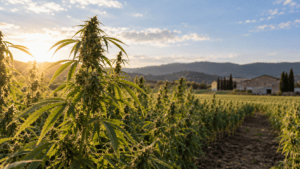
Industrial hemp crop

Hemp refers to varieties of Cannabis sativa L. containing less than 0.3% THC (the EU limit since 2023; it was previously 0.2%), which serve as a raw material for countless industries such as textiles, biodiesel and bioplastics.

Although it looks just like marijuana, thanks to its non-psychoactive nature industrial hemp crops can be authorised in Spain. The possibility of growing industrial hemp with authorisation, together with its potential as an emerging industry, means that, despite the lack of awareness that still exists in Spain, more and more people see industrial hemp as an opportunity.

Last year the first industrial hemp company in Cantabria, Cañamera del Pas S.L., was set up in Piélagos.

The Catalan Department of Agriculture has gone from registering just 6 hectares of industrial hemp to 300 in the last five years. In an article published in El País, the Catalan Government’s Director of Agriculture, Elisa Guillaumes , spoke of an “avalanche of new enquiries about the legal requirements”, highlighting the interest in the sector and praising the huge future potential of industrial hemp.

In Galicia hemp is also gaining ground, with companies such as Celtic Hemp Deza, which currently manages around 100 hectares of industrial hemp and has set up another company, Industrias Bio Hemp, to process it. Gerardo Lázara, a grower at the company, is also behind the creation of the Galician Hemp Association, which brings local producers together to standardise prices and quality, provide training and jointly promote every area of the sector.

The climate of the Iberian Peninsula makes Spain an ideal place to grow industrial hemp, thanks to the hours of sunlight and the irrigation the plant needs. Hemp grows fast and thrives in temperate or warm climates with plenty of moisture.

In Extremadura, research on industrial hemp has been carried out through projects such as those of the Extremadura Agri-Food Technology Centre (CTAEX), which has led an international study to develop the hemp sector through its use in creams, gels and sunscreens. The Extremadura Scientific and Technological Research Centre (CICYTEX) has also run trials of industrial hemp cultivation, with results showing the industry is viable.

Uses of industrial hempThe Valencia region has also promoted research projects on the viability of industrial hemp.

Since 2018, importing hemp into the Canary Islands, whether raw or processed, has been subsidised by the EU, under a support scheme similar to the one for flax on the mainland.
Industrial hemp is a biodegradable plant that needs less fertiliser, water and pesticides than other crops. In addition, hemp is a raw material for countless industries thanks to its many applications: textiles, fuel, eco-construction, food, agriculture, seed production, lubricants and more.

This range of potential uses across many sectors has led hemp cultivation to be seen as a great hope against rural depopulation, one of Spain’s most pressing problems, bringing economic benefits and creating jobs.

The legal status of industrial hemp in Spain

Today hemp can be grown in Spain as long as its THC content stays below the legal limit (0.3% under the current EU rules). Only varieties listed in the EU Common Catalogue of Varieties of Agricultural Plant Species may be grown, and Spanish regulations also set the rules for aid to fibre crops. Seeds must be EU-certified for the crop to be legal.

In Spain the only legal uses of hemp are strictly industrial ones, namely fibre and seed production, and it is not legally possible to go beyond them: anything involving the processing or handling of the flower requires a licence, obtained before the crop is planted, from the Spanish Agency of Medicines and Medical Devices (AEMPS).

To grow hemp you need authorisation from the regional Department of Agriculture of the relevant Autonomous Community, and you must use certified seeds from authorised suppliers. It is also advisable to carry out tests as the plant’s growth cycle progresses to monitor THC levels and, if necessary, show the authorities that you have acted with due diligence.

Hemp crop and the authorities
It is advisable to make sure the authorities know about the crop.

It is also advisable to inform the Guardia Civil so that they know the crop exists, to avoid problems arising from misunderstandings if the plantation is discovered.
​

Despite Spain’s huge potential and the gradual spread of certified industrial hemp crops in the country, there is still a long way to go. Clear, up-to-date regulation is badly needed to widen the permitted uses of hemp, boosting a green industry with enormous potential to create sustainable jobs and clean economic activity that can strengthen Spain’s business fabric.

For now Spain is lagging behind on regulation and risks being unable to catch up with countries that are already regulating in a way that fits the 21st century.

Need legal advice?

At S&F Abogados we specialise in cannabis law. Discover our service for CBD and hemp businesses, book an online consultation or call us on +34 919 532 802.