
Cannabis cosmetics are legal in the European Union as long as they use permitted hemp ingredients and comply with Regulation (EC) 1223/2009 on cosmetic products. The word “cannabis” on a label says very little: a cream may contain hemp seed oil, leaf extract or CBD, and each ingredient follows different rules. On top of that, 2026 is a year of change for CBD in cosmetics. We explain which ingredients can be used, what THC limits apply, what the CJEU said in the Kanavape case and what is forbidden.
Quick summary
Are cannabis cosmetics legal? Yes, if their hemp ingredients do not come from controlled parts of the plant and the product complies with Regulation 1223/2009.
Which ingredients are used? Mainly hemp seed oil, Cannabis sativa leaf extract and CBD, identified on the label by their INCI name.
What is changing? The EU scientific committee has set safe use of CBD at up to 0.19% and the Commission is preparing specific restrictions.
What is forbidden? Presenting a cosmetic as a medicine, advertising healing effects or misleading consumers about its content.
What is a cannabis cosmetic
Creams, serums, lip balms, shampoos, massage oils and masks containing a derivative of the Cannabis sativa plant are sold as cannabis cosmetics, almost always made from industrial hemp varieties with very little THC. None of these products has a psychoactive effect: THC, the cannabinoid that gets you high, has no place in a cosmetic beyond traces.
Legally, a cosmetic is a substance or mixture intended to be placed in contact with the external parts of the body (skin, hair, nails, lips) or with the teeth and mucous membranes of the mouth, in order to clean, perfume, protect, keep them in good condition or correct body odours (Art. 2 of Regulation 1223/2009). That definition sets the limits of what can be sold and advertised, as we will see below.
Hemp ingredients that can be used
The European CosIng database lists cosmetic ingredients and their INCI name, which is the one that must appear in the ingredient list. The most common cannabis-derived ingredients are:
- Hemp seed oil (INCI: Cannabis Sativa Seed Oil): obtained by pressing the seeds. It is rich in omega 3 and omega 6 fatty acids and is used as an emollient and moisturiser. It contains practically no cannabinoids, so it is not CBD.
- Leaf extract (INCI: Cannabis Sativa Leaf Extract): added to CosIng in February 2021 with skin conditioning functions.
- Cannabidiol (INCI: Cannabidiol): CosIng distinguishes synthetic CBD and, since February 2021, CBD derived from extract, tincture or resin of cannabis, with functions such as anti-sebum, antioxidant and skin conditioning or protecting.
- Other derivatives: seed water or extracts, hemp proteins or plant waxes, each with its own entry.
Note: CosIng is an information tool of the Commission, not a law. The fact that an ingredient appears in it does not guarantee that it is legal in every product, nor does it replace the safety assessment.
The origin of the plant and the THC limit
Annex II of Regulation 1223/2009 (entry 306) bans in cosmetics the narcotics listed in Schedules I and II of the 1961 Single Convention, which controls cannabis, defined as the flowering or fruiting tops, and its extracts, tinctures and resins. Seeds and leaves not accompanied by the tops fall outside that definition. This is why the Spanish medicines agency (AEMPS) only accepts CBD that does not come from controlled parts, such as synthetic CBD or CBD obtained from seeds and leaves.
As for THC, two things should be kept apart:
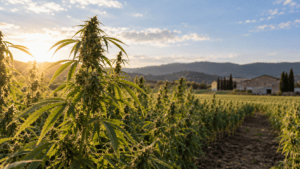
- In the field: the CAP only accepts hemp varieties with a maximum of 0.3% THC. This is an agricultural requirement, not a limit for the final product. We explain it in our guide to industrial hemp cultivation.
- In the cosmetic: THC is a controlled substance and the safety report must assess any presence, even if unintended. The Scientific Committee on Consumer Safety (SCCS) considers THC impurities safe up to 0.00025% in dermal and oral products.
You can read about the difference between the two cannabinoids in our article on the differences between THC and CBD.
The CJEU Kanavape ruling
In the Kanavape judgment (case C-663/18) of 19 November 2020, the Court of Justice of the EU held that CBD extracted from the whole Cannabis sativa plant is not a narcotic drug within the meaning of the 1961 Convention. It also ruled that a Member State cannot ban the sale of CBD lawfully produced in another Member State unless it shows a real risk to public health.
The case concerned an e-cigarette, but it is the main argument for the free movement of CBD cosmetics made in other EU countries. Even so, some national authorities still apply the plant-origin criterion, so documenting the ingredient is key. You can see how each country treats CBD in our article on CBD in Europe.
What is changing for CBD in 2026
- SCCS opinion: in its final opinion SCCS/1685/25, adopted in March 2026, the committee considers CBD safe at concentrations up to 0.19% in dermal and oral products, and THC impurities up to 0.00025%. It does not assess products that may be inhaled.
- Draft restriction: in July 2026 the Commission notified the WTO of a draft regulation amending Regulation 1223/2009, which includes restrictions on CBD under the safe-use conditions set by the SCCS. It is not final yet.
- Classification as toxic for reproduction: following a proposal by the French agency ANSES, ECHA’s Committee for Risk Assessment has recommended classifying CBD as toxic for reproduction. If the Commission adopts a category 1B classification, Article 15 of Regulation 1223/2009 bans the substance in cosmetics unless an express exemption is granted. The industry has already announced it will seek that exemption.
If you make or sell CBD cosmetics, review your formulas now: a product with more than 0.19% CBD may be pushed off the market once the restriction is approved.
Labelling and claims
The label of a cannabis cosmetic must comply with Article 19 of Regulation 1223/2009: ingredient list with INCI names, responsible person, content, batch, date of minimum durability, precautions and function, in Spanish if sold in Spain. Claims must meet the common criteria of Regulation (EU) 655/2013: truthfulness, evidential support, honesty and fairness.
In practice, this means:
- Not calling a product “CBD” when it only contains hemp seed oil, and not highlighting an amount of CBD you cannot prove with batch analysis.
- Not using slogans such as “with marijuana” or images suggesting a psychoactive effect the product does not have.
- Being able to prove with studies any effect you advertise, such as “moisturises for 24 hours”.
What is forbidden
- Presenting it as a medicine: a cosmetic cannot promise to treat or prevent diseases. Phrases such as “relieves arthritis”, “cures acne”, “for psoriasis” or “anti-inflammatory” turn it into an unauthorised medicine. In Spain, Royal Decree 1907/1996 also bans advertising of products with alleged health purposes.
- Presenting it for ingestion: a CBD oil with a dropper and “sublingual” doses is not a cosmetic. CBD for human consumption is not authorised as a food. We explain this in our guide on whether CBD is legal in Spain.
- Using controlled parts of the plant: flower extracts with THC or ingredients without documented origin.
- Selling it without completing the formalities: without a responsible person, a safety report or notification on the CPNP portal. The steps are in our guide to the requirements for making, importing and selling CBD cosmetics.
Frequently asked questions about cannabis cosmetics
Do cannabis cosmetics have psychoactive effects?
No. They are made with industrial hemp and ingredients such as seed oil, leaf extract or CBD, which have no psychoactive effect. THC can only appear as an impurity in minimal amounts.
Are hemp oil and CBD the same thing?
No. Hemp seed oil (Cannabis Sativa Seed Oil) is a vegetable oil with hardly any cannabinoids; CBD (Cannabidiol) is a cannabinoid obtained from other parts of the plant or by synthesis.
How much CBD can a cosmetic contain?
The SCCS considers up to 0.19% safe in dermal and oral products. The Commission is preparing a restriction along those lines that is not yet final.
Can a CBD cosmetic made in another EU country be sold in Spain?
Yes, if it complies with Regulation 1223/2009 and is notified on the CPNP. The Kanavape ruling strengthens free movement, but you should document the origin of the CBD carefully.
Can I advertise that my cannabis cream relieves pain?
No. Attributing therapeutic effects to a cosmetic is forbidden and can lead to the product being withdrawn and to penalties.
You may also be interested in: CBD cosmetics: requirements for manufacturing, importing and selling them in Spain · Is CBD legal in Spain? Legal status in 2026, product by product · CBD oil business in Spain: what it is, how it is used and can you sell it?
Do you need legal advice?
At S&F Abogados we have spent 14 years advising brands, manufacturers and distributors of hemp and CBD cosmetics: formula and label reviews, claims, ingredient documentation and adaptation to regulatory changes. Discover our service for CBD and hemp businesses, book your online consultation or call us on 919 532 802.