
Testing positive in a roadside drug test (drogotest) in Spain generally means a 1,000 euro fine and the loss of 6 points from your licence. It is enough for the test to detect drugs in your body: the substance does not need to affect your driving. In this guide to the drug test fine in Spain we explain what the test detects, how the saliva test works, what penalty applies, how long the fine takes to arrive and when it is worth appealing.
Short answer: if a driver tests positive in a drug test in Spain, they commit a very serious administrative offence (articles 14 and 77.c of the Spanish Traffic Act): a 1,000 euro fine and 6 points off, even without noticing any effects. It is only a crime if driving under the influence is proven (article 379.2 of the Criminal Code) or if the driver refuses the test.
Quick summary
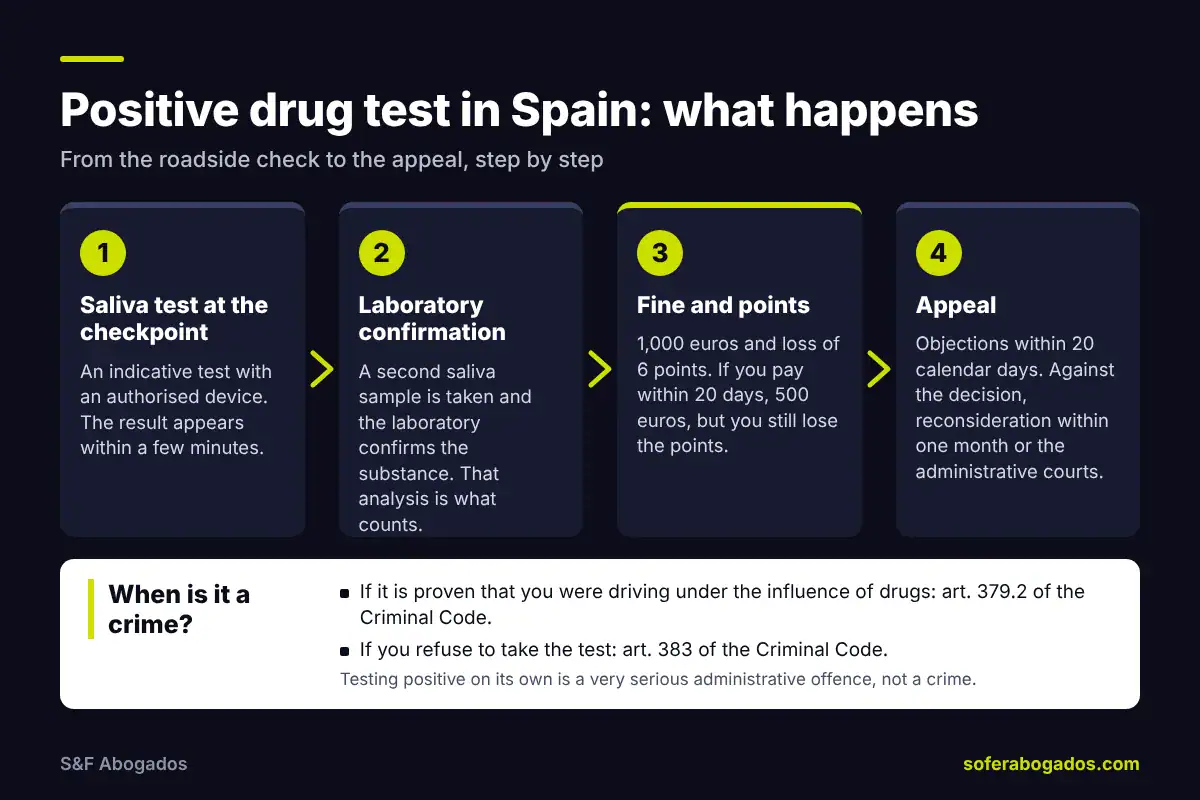
Fine: 1,000 euros and loss of 6 points for driving with drugs in your system (500 euros if you pay within 20 calendar days, but you still lose the points).
How it works: an indicative saliva test at the checkpoint and, if positive, a second sample analysed in a laboratory. That analysis is what counts.
How long you test positive: it depends on the substance, the dose and the person. There is no safe time limit.
Refusing the test: it is a crime (article 383 of the Criminal Code).
Appeal: objections within 20 calendar days of notification and, against the decision, an appeal for reconsideration within one month or the contentious-administrative courts.
Have you been fined for a drug test or for carrying cannabis? We can help you appeal your cannabis fine.
What happens if you test positive in a drug test?
Driving with drugs in your system is a very serious offence (article 77.c of the Spanish Traffic Act, approved by Royal Legislative Decree 6/2015). The prohibition is set out in article 14, and the consequences are:
- A 1,000 euro fine (article 80.2).
- Loss of 6 points from your driving licence (annex II).
- You cannot keep driving after testing positive at the checkpoint, as explained by the DGT magazine.
This table summarises the most common situations:
| Situation | Type | Consequence | Legal basis |
|---|---|---|---|
| Testing positive (drugs in your system) | Very serious administrative offence | 1,000 euros (500 with early payment) and 6 points | Arts. 14, 77.c and 80.2 of the Traffic Act |
| Driving under the influence of drugs | Crime | Prison of 3 to 6 months, a fine of 6 to 12 months or 31 to 90 days of community service, and loss of the licence for 1 to 4 years | Art. 379.2 of the Criminal Code |
| Refusing the test | Crime | Prison of 6 months to 1 year and loss of the licence for 1 to 4 years | Art. 383 of the Criminal Code |
| Prescribed medicine taken for therapeutic purposes | No offence if you are fit to drive | Carry your prescription or medical report | Art. 14.1 of the Traffic Act |
It is important to distinguish the administrative penalty from the crime. A positive result only shows that there is a substance in your body. To convict you under article 379.2 of the Criminal Code, it must also be proven that you were driving under the influence of drugs, meaning they affected your ability to drive (for example, through the signs recorded by the officers or an accident). In that case you need a specialist criminal lawyer from the very beginning.
What is the drug test
The drogotest is the saliva test that traffic officers use to check whether a driver has drugs in their system. It is regulated by article 14 of the Spanish Traffic Act, which requires all drivers to undergo these tests.
Unlike the breathalyser, the roadside drug test does not measure a quantity: the result is positive or negative. The quantity and the specific substance are determined later by the laboratory.
Which drugs does the traffic test detect
According to the DGT (Spain’s traffic authority), the roadside saliva test detects five types of drugs, with cannabis and cocaine being the most common. Depending on the model, the devices usually detect:
- Cannabis (THC)
- Cocaine
- Amphetamines and methamphetamines
- MDMA
- Opiates
- Benzodiazepines
The laboratory analysis is much broader: the DGT states that its equipment can detect up to 40 substances, in amounts as small as one nanogram.
CBD is not a prohibited drug, but many CBD products contain small amounts of THC that can cause a positive result. We explain this in our article on the differences between CBD and THC.
How the saliva drug test works at a checkpoint
The law provides that the drug test consists of a saliva test with an approved device followed by a laboratory analysis of a saliva sample of sufficient quantity (article 14.3). In practice, according to the procedure described by the DGT, the steps are:
- Indicative test at the checkpoint. The officer tells you that you are obliged to take it and collects a saliva sample with the device. The result appears within a few minutes.
- Observation of signs. At the same time, officers record whether you show signs that could affect your driving (nervousness, tremors, sweating…). This information matters if a crime is being considered.
- Evidential sample. If the indicative test is positive, a second saliva sample is taken and sent sealed to the laboratory. This analysis confirms the positive result, the substance and its quantity.
- Counter-test. You are entitled to request one. Under article 14.5 it will preferably be a blood test, carried out by health staff at a health centre or hospital. If the counter-test confirms the positive result, you pay for it.
- Chain of custody and analysis. The samples travel sealed to the laboratory, which checks that the chain of custody has been maintained, analyses them and signs the report that is added to your file.
If you were not informed of your right to a counter-test at the checkpoint, or the chain of custody was not respected, it is worth reviewing with a lawyer: it may be a ground for appeal.
Police and Guardia Civil drug tests: are there any differences?
Not in essence. On interurban roads the checkpoint is usually run by the Guardia Civil traffic unit; in towns, by the local police; and in regions with powers over traffic, such as Catalonia or the Basque Country, by their regional police. Who processes the fine changes, but the obligation to take the test, the saliva procedure and the penalty are the same because they are set by the Traffic Act.
Drug test laboratory result: what happens if it does not confirm the positive
The roadside positive is only indicative. What supports the fine is the laboratory result on the second sample. Therefore:
- If the laboratory does not confirm the presence of drugs, there are no grounds to fine you for drugs.
- If the test fails in the laboratory because the sample is insufficient, poorly preserved or there is no record of the chain of custody, the result can be challenged.
- You are entitled to access the file and obtain copies of its documents, including the laboratory report (article 53 of Law 39/2015). Request it before deciding whether to pay or appeal.
Can I refuse to take the drug test?
No. Refusing to take the tests when an officer requires you to is a crime under article 383 of the Criminal Code, punishable by six months to one year in prison and loss of the right to drive for one to four years. The consequences are much more serious than testing positive, so refusing is never a good strategy.
How long do you test positive at a drug checkpoint?
There is no exact answer: how long a substance keeps showing up in saliva depends on the substance, the dose, the frequency and method of use, each person’s body and the sensitivity of the analysis. The Society of Forensic Toxicology notes that, in general, the detection window in saliva is similar to that in blood and is measured in hours, and that a positive result indicates recent use, not that you are impaired.
These figures come from a scientific review of detection windows in saliva using laboratory methods (Verstraete, Annales de Toxicologie Analytique, 2002). They are indicative and come from specific studies; they are not guaranteed time limits:
| Substance | Detection in saliva according to the review |
|---|---|
| Cannabis (THC), smoked | In one study, the last positive appeared on average at around 31 hours, with cases between 1 and 72 hours |
| Cocaine | 5 to 12 hours after a single dose; its metabolite (benzoylecgonine), 12 to 24 hours with sensitive methods |
| Amphetamine | 20 to 50 hours |
| Heroin and morphine | 6-acetylmorphine, 0.5 to 8 hours; morphine, 12 to 24 hours |
| Benzodiazepines (flunitrazepam 1 mg) | Did not exceed 6 hours in the study cited |
The drug test detects the presence of the substance, not whether you are under its effects. That is why you can test positive even if you no longer feel anything, and regular users may test positive for longer.
How long does cannabis stay in a saliva test
This is the most common question. Scientific data show a wide variation between people (1 to 72 hours in the study cited), and THC can remain deposited in the mouth after smoking. No time limit guarantees a negative result. If you have already been fined, see how to appeal the fine.
How to test negative in a saliva test: what the law says
From a legal point of view, the only safe way not to test positive is not to drive after using drugs. No product or waiting time protects you: the penalty is not based on the rapid test but on the laboratory analysis of the second sample, which is far more sensitive. And refusing the test is a crime. If you have used drugs, leave the car and use another means of transport. If you take medication, carry your prescription or medical report: article 14.1 excludes substances used under prescription and for therapeutic purposes, provided you are fit to drive.
False positive in the drug test
A false positive occurs when the test indicates the presence of a substance you have not taken, or when the result is caused by a medicine or a legal product. Some common causes are:
- Medicines containing codeine, benzodiazepines or other active ingredients.
- CBD products containing traces of THC.
- Errors in collecting, storing or keeping the chain of custody of the sample.
If you believe your result is a false positive, keep the prescriptions or packaging of whatever you took and request the counter-test. These documents are key to an appeal.
How long does a fine for testing positive for drugs take to arrive
If you test positive at the checkpoint, the fine is not usually issued on the spot: the laboratory result has to come first. That is why it is normal for the notification to take several weeks.
The Traffic Act sets these time limits (article 112):
- Limitation period for the offence: 6 months from the day of the events, for serious and very serious offences. It is interrupted when the authorities notify you or take steps to locate you.
- Expiry of the procedure: 1 year. If no decision is issued within one year of the procedure starting, it expires and is closed.
If you have not received the fine, check the Traffic Penalties Edictal Board (TESTRA) and your Road Electronic Address (DEV): many notifications are published there. Consult a lawyer before assuming a fine has lapsed.
How to appeal a drug test fine in Spain
Yes, you can appeal. When you receive the notification of the complaint you have two options:
- Pay with a 50 % discount (500 euros) within 20 calendar days of notification. By paying, you waive the right to submit objections, the procedure ends and you still lose the 6 points; the only remaining option would be the contentious-administrative courts (article 94).
- Submit objections within the same 20 calendar days (article 95), providing any evidence you have: prescriptions, medical report, counter-test, defects in the report or in the chain of custody.
If the authorities issue a penalty decision, you can file an optional appeal for reconsideration (recurso de reposición) within one month before the body that issued it (article 96). If it is not resolved within one month, it is deemed rejected and the contentious-administrative courts become available. Bear in mind that documents you could have submitted earlier are not considered at that stage, so it is important to include everything in your objections.
Is it worth appealing a drug test fine?
It depends on your case. It is worth looking into if any of these situations apply:
- The positive result may be due to a medicine or a legal product.
- You were not informed of your right to a counter-test or were not allowed to take one.
- There are defects in the chain of custody of the sample, in the laboratory deadlines or in the checkpoint report.
- The fine was notified late or the procedure may have lapsed or expired.
- You need to keep your points, for example because you drive for work or have few points left.
If none of these circumstances apply, paying with the discount may be the cheapest option. A lawyer can review the file before the 20-day period ends and tell you whether you have real options.
Template appeal against a drug test fine
There is no single template that works for every case: objections must be based on the facts and documents in your file (checkpoint report, laboratory result, prescriptions, etc.). A generic letter rarely succeeds. It is best to request the complete file and draft the objections based on it.
Drug tests and cannabis use outside the car
The drug test only concerns driving. If you are found using or carrying cannabis in a public place, the penalty is different and is governed by the Public Safety Act. We explain it in our guide on the fine for using or possessing drugs in public.
Frequently asked questions about the drug test
How much is the fine for testing positive for drugs while driving?
1,000 euros and the loss of 6 points. If you pay within 20 calendar days of notification, the fine is reduced to 500 euros, but you still lose the points.
Is the DGT drug test illegal?
No. The test is provided for in the Traffic Act and is mandatory. What can be challenged is how it was carried out in your specific case: the device, the sampling, the chain of custody or respect for your rights.
If a driver tests positive in a drug test, do they always commit a crime?
No. Testing positive is, in principle, a very serious administrative offence punished with 1,000 euros and 6 points. It is only a crime if it is proven that they were driving under the influence of drugs (article 379.2 of the Criminal Code) or if they refuse the test (article 383).
How long do you test positive in a saliva drug test?
It depends on the substance, the amount, the frequency of use and each person. In scientific studies, THC has been detected in saliva between 1 and 72 hours after smoking. There is no safe period that guarantees a negative result, so the only way to avoid the penalty is not to drive after using drugs.
How long does a fine for testing positive for drugs take to arrive?
Usually several weeks, because the laboratory analysis of the second sample has to be completed first. The offence lapses after 6 months if you are not notified and no steps are taken to locate you, and the procedure expires if no decision is issued within one year.
Which drugs does the traffic saliva test detect?
The roadside test detects five types of drugs, mainly cannabis and cocaine, as well as others such as amphetamines, opiates or benzodiazepines depending on the device. The laboratory analysis of the second sample can identify up to 40 substances.
What happens if the laboratory does not confirm the positive drug test?
If the laboratory analysis of the second sample does not confirm the presence of drugs, there are no grounds for a drug fine, because the roadside test is only indicative. Request a copy of the file to check the result.
You may also be interested in: Fine for smoking weed in the street in Spain: Article 36.16 explained · THC vs CBD: what they are, the differences and what is legal in Spain · Madrid region admits there are no rules allowing councils to fine drug use or possession in public
Fined for a drug test in Spain?
At S&F Abogados we review your file, tell you whether your fine can be appealed and prepare your objections on time. We work throughout Spain.
Call us on +34 637 655 294 (fine appeals, office hours) or write to us from our contact page.